

From Colonial Kitchens to Modern-Day Cottage Bakeries
There are some foods that seem to carry a little bit of history in every spoonful.
Apple butter is one of them.
Dark, rich, warmly spiced and intensely apple-flavored, apple butter has been finding its way onto tables for generations. It has been spread on freshly baked bread, spooned onto biscuits, paired with cheese, used in cakes and cookies, and tucked into countless family recipes.
But despite its name, there isn’t a stick of butter anywhere in traditional apple butter.
So where did it come from?
And how did something created as a practical way to preserve a harvest become one of the most beloved flavors of autumn?
Let’s take a trip through time—from European monasteries and colonial American kitchens to Appalachian apple-butter gatherings and today’s home kitchens and cottage food businesses.
🍎 Before America: The European Roots of Apple Butter
The story of apple butter actually begins long before the American colonies.
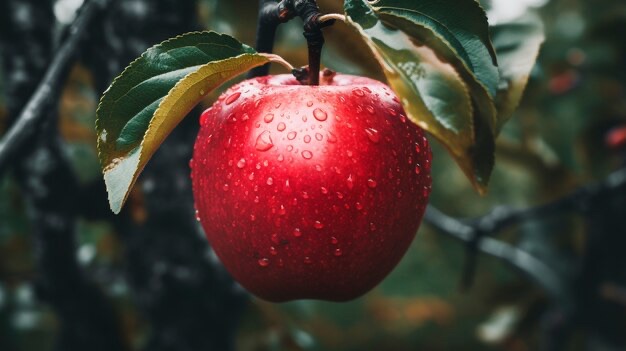
Fruit butters have roots in medieval Europe, particularly in regions that are now parts of Belgium, the Netherlands and Germany. Monasteries maintained extensive orchards, and preserving the harvest was essential when fresh fruit wouldn’t be available during the long winter months. (Back Then History)
The basic idea was wonderfully simple:
Cook fruit slowly until much of its moisture disappears and the fruit becomes thick, concentrated and spreadable.
There was no need for modern refrigeration.
No electric slow cooker.
No commercial pectin.
Just fruit, heat, time and patience.
Apple butter was a particularly useful way to make an abundant apple harvest last longer.
And that idea would eventually cross the Atlantic.
🇺🇸 Apples Arrive in the American Colonies
European settlers brought apple trees and apple-growing traditions with them to North America.
By the 1600s, orchards were becoming an important part of colonial farms. Historical records show apple orchards established in places such as Maryland, Virginia and North Carolina, while apples became useful for everything from eating and baking to cider, vinegar, drying and preserving. (NC Historic Sites)
For an early American family, an apple tree could provide much more than dessert.
Apples could be:
- Eaten fresh
- Fried or stewed
- Baked into pies
- Dried for winter
- Made into applesauce
- Pressed into cider
- Turned into vinegar
- Preserved as apple butter
And that last one was especially valuable.
Because when you were feeding a family without a grocery store around the corner, wasting food wasn’t really an option.
You used what you had.
You preserved what you could.
And you made something delicious in the process.
🏡 The Pennsylvania Dutch Connection
When German-speaking immigrants settled in Pennsylvania and surrounding regions during the 17th and 18th centuries, they brought European food traditions with them—including methods of preserving fruit. Apple butter became strongly associated with Pennsylvania Dutch foodways. (Experience Pennsylvania)
The name “Pennsylvania Dutch” can be misleading.
It doesn’t mean these communities were primarily Dutch.
The term developed from Deutsch, the German word for German.
Apple butter became particularly important in these communities because it was practical, economical and perfectly suited to the abundance of apples available in the region.
It could be made in large quantities and stored for later use.
And, perhaps just as importantly, making it became a community activity.
🔥 The Apple Butter Kettle
Now imagine making apple butter before electricity.
No food processor.
No electric range.
No instant temperature control.
Instead, families might gather around a large kettle suspended over an open fire.
Apples were peeled, cored and cut.
Cider or another liquid could be added.
Then the long process of cooking began.
And someone had to stir.
And stir.
And stir some more.
Historical accounts describe apple butter being cooked in large copper, brass or iron kettles, with long wooden paddles used to keep the mixture moving so it wouldn’t scorch. (National Park Service)
It could take hours.
But there was something wonderful about that work.
People gathered.
Neighbors helped.
Children watched.
Stories were told.
And while the apples slowly transformed, the kitchen—or the yard around the kettle—became a place of community.
❤️ The Apple Butter “Bee”
In parts of Pennsylvania, the communal making of apple butter became known as an apple butter bee.
And “bee” in this context wasn’t about insects.
It referred to a gathering where people came together to accomplish a large amount of work.
Historical accounts describe neighbors gathering to peel and cut apples, prepare the cider and take turns stirring the enormous kettle. (Monroe County Historical Association)
The work could be exhausting.
But it was also social.
There was conversation.
There was laughter.
There were meals.
There were children underfoot.
And there was the unmistakable smell of apples cooking over a fire.
When the work was finished, families had something to show for it—jars and crocks of apple butter that could help carry them through the months ahead.
In other words:
Preservation became celebration.
🍂 Apple Butter Finds a Home in Appalachia
Apple butter eventually became deeply connected with Appalachian food traditions as well.
Apples thrived in many mountain regions, and preserving the harvest was essential. The Great Smoky Mountains National Park notes that families made apple butter and applesauce in large quantities, sometimes cooking apples with cider and adding sugar and cinnamon near the end. (National Park Service)
In Appalachia, apple butter making could become a yearly family tradition.
And some families still gather today to continue the practice.
One modern account of Appalachian apple-butter gatherings describes families gathering to peel and chop apples one day, then building the fire and beginning the long cooking process the next morning. (The Washington Post)
That says something important about traditional food.
A recipe can survive because people like the way it tastes.
But a tradition survives because people attach meaning to it.
🥄 So Why Is It Called “Butter”?
This is one of the questions we hear most often.
Where’s the butter?
There isn’t any.
The word refers to the smooth, thick, spreadable consistency.
Just as peanut butter is spreadable, apple butter has a thick, almost buttery texture.
But the richness comes from concentrating the apples themselves.
The longer apples cook, the more their water evaporates and the more concentrated their natural sugars and flavors become.
That long cooking process is what gives traditional apple butter its characteristic deep color and intense flavor.
It’s not simply applesauce with a different name.
It’s apples transformed by time.
🍎 Apple Butter Was the Original “Waste Not, Want Not”
One of the things I love most about apple butter is that it represents an idea that seems especially important today:
Use what you have.
A harvest doesn’t have to be perfect.
An apple doesn’t have to look beautiful to become something delicious.
Historically, families found ways to use apples in nearly every condition—from fresh fruit to dried apples, cider, vinegar, sauces and preserves. (NC Historic Sites)
Apple butter was part of that philosophy.
Instead of asking:
“What can I do with these apples?”
They were asking:
“How can we make sure none of this harvest goes to waste?”
That’s a lesson worth keeping.
🫙 From Crocks to Canning Jars
Before modern home canning became widespread, apple butter could be stored in crocks or other containers in cool, dry places.
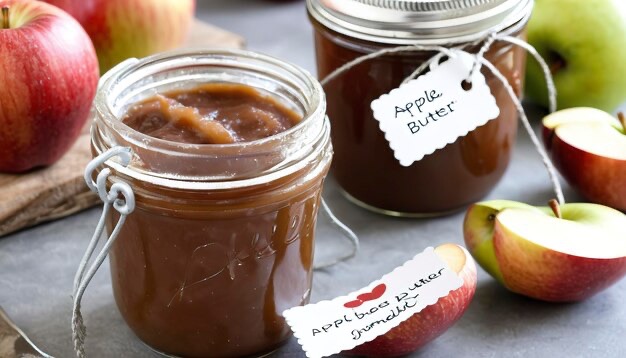
The National Park Service notes that before widespread home canning, apple butter was often kept in large crocks. (National Park Service)
Eventually, preserving food in glass jars became increasingly common.
And that changed the way families stored and shared their harvest.
Instead of a large crock sitting in the pantry, apple butter could be divided into smaller jars.
Those jars could be saved.
Shared.
Traded.
Given as gifts.
And eventually sold.
The humble apple butter jar became more than food storage.
It became a way of sharing something homemade.
🏪 From Family Tradition to Local Markets
As America changed, so did the way people made and purchased food.
Home gardens and family farms remained important, but commercial food production expanded.
Apple butter became available in stores and markets, while family recipes continued to be passed down.
Some producers maintained traditional methods.
Others developed new variations.
And the flavor began finding its way into more than just a piece of bread.
Apple butter became an ingredient.
It could bring moisture and spice to cakes.
Depth to cookies.
Sweetness to breads.
Flavor to pastries.
And a beautiful autumn character to desserts.
👩🍳 Apple Butter in the Modern Kitchen
Today, we have something our ancestors never had:
options.
We can make apple butter the old-fashioned way, slowly cooking apples for hours.
We can use a slow cooker.
We can use a modern stovetop method.
And modern bakers have discovered countless ways to incorporate apple butter into baked goods.
It can become a filling.
A swirl.
A glaze.
A frosting ingredient.
A breakfast spread.
Or the secret ingredient that makes a fall dessert taste like it has been baking in Grandma’s kitchen all afternoon.
Even modern professional baking recognizes its usefulness. Contemporary recipes use apple butter as a concentrated apple flavor in pastries and other baked goods, sometimes even creating it from applesauce as a shortcut. (King Arthur Baking)
The tools have changed.
The tradition hasn’t.
🧺 From Grandma’s Kitchen to the Cottage Bakery
And this is where the story gets especially exciting for us.
Because today, small home-based and cottage food businesses are bringing traditional foods back into the spotlight.
A modern cottage kitchen might not have a giant copper kettle hanging over an outdoor fire.
It might have a stand mixer sitting on the counter.
A convection oven.
A digital thermometer.
A refrigerator humming in the background.
But the idea is remarkably similar.
Take something simple.
Treat it with care.
Make it into something special.
And share it with someone else.
That’s exactly the kind of tradition we love at Not Your Grams Kitchen.
We’re surrounded by modern conveniences, but we’re still drawn to the foods that remind us of where we came from.
❤️ Why Apple Butter Belongs at Not Your Grams Kitchen
At Not Your Grams Kitchen, the name itself is about remembering the food that made us feel at home.
Apple butter fits that story perfectly.
It isn’t flashy.
It doesn’t need expensive ingredients.
It doesn’t require complicated equipment.
It simply requires good apples, warm spices, patience and a little love.
And perhaps that’s why it has survived for so many generations.
Because sometimes the simplest things are the hardest to replace.
🍏 A Spoonful of History
Think about what happens when you open a jar of apple butter.
You’re looking at something that connects you to an extraordinarily long culinary tradition.
European fruit-preserving traditions.
Colonial American orchards.
Pennsylvania Dutch kitchens.
Appalachian family gatherings.
Farm kitchens.
Community apple-butter bees.
Country stores.
Farmers markets.
And now, modern home kitchens and cottage food businesses.
That’s a lot of history for something you can spread on a biscuit.
And that’s exactly what makes food so fascinating.
Every recipe has a story.
Every ingredient has a past.
And sometimes, the best way to understand history is to taste it.
🍎 The Not Your Grams Kitchen Philosophy
We believe old recipes deserve another chance.
Not necessarily to be copied exactly as they were made hundreds of years ago—but to be remembered, respected and reimagined.
Because traditions aren’t meant to sit frozen in time.
They’re meant to be carried forward.
Your grandmother may have made apple butter in a heavy pot.
Her grandmother may have made it over a fire.
Someone before her may have learned the technique from a neighbor.
And today, you might be making it in a slow cooker in your own kitchen.
Different kitchen.
Different equipment.
Different generation.
Same love.
That’s the beautiful thing about food.
🥄 From Our Kitchen to Yours
So the next time you spread apple butter across a warm biscuit, toast a piece of homemade bread, or use it in one of your favorite fall desserts, take a moment to think about what you’re tasting.
You’re not just tasting apples.
You’re tasting preservation.
Resourcefulness.
Community.
Family.
Autumn.
And generations of people who understood that a good harvest was something worth celebrating.
Here at Not Your Grams Kitchen, we’re proud to add our own chapter to that story.
Because old recipes don’t have to disappear.
Sometimes they just need someone willing to bring them back to the table.
From colonial kitchens to modern cottage kitchens, apple butter has traveled a long way.
And we’re pretty happy that it found its way into ours.
❤️ Not Your Grams Kitchen
Old Recipes. New Memories. Always Made With Love.
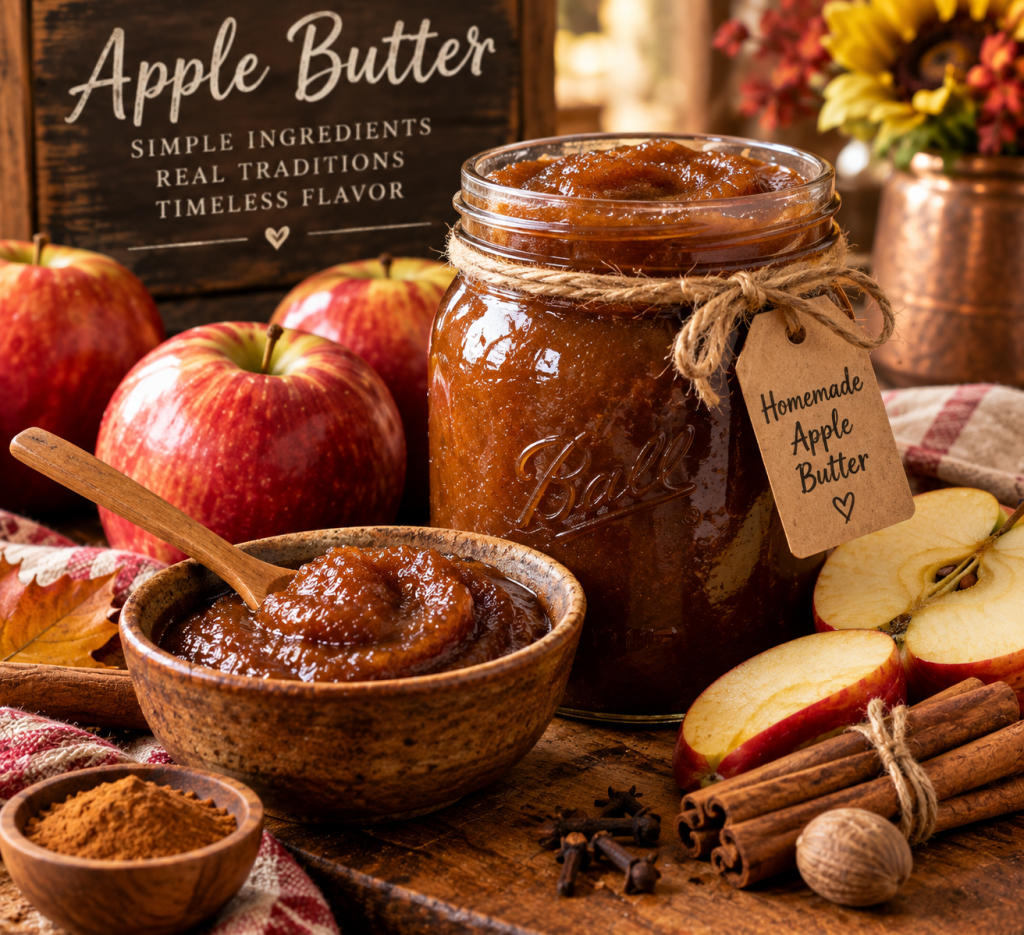
🍎 Not Your Grams Kitchen
Brown Sugar Chai Apple Butter
A Little Old-Fashioned. A Little Unexpected. Completely Delicious.
Ingredients
Apple Base
- 5 pounds sweet-tart apples, peeled, cored, and chopped
Honeycrisp, Gala, Fuji, Pink Lady, or a combination work beautifully. - 1 cup apple cider
- ¾ cup packed dark brown sugar
- ¼ cup pure maple syrup
- 2 tablespoons lemon juice
- 1 tablespoon apple cider vinegar
- 2 teaspoons pure vanilla extract
Not Your Grams Spice Blend
- 2 teaspoons ground cinnamon
- 1 teaspoon ground ginger
- ½ teaspoon ground cardamom
- ½ teaspoon ground nutmeg
- ¼ teaspoon ground allspice
- ⅛ teaspoon ground cloves
- ½ teaspoon fine sea salt
Optional Signature Finish
- 1 tablespoon unsalted butter
- 1 teaspoon finely grated orange zest
🍏 Instructions
1. Build the Apple Base
Place the prepared apples into a large slow cooker.
Pour in the apple cider and lemon juice.
Add the brown sugar, maple syrup, vinegar, vanilla, and all of the spices.
Stir everything together until the apples are thoroughly coated.
2. Let the Apples Transform
Cover and cook on LOW for 8–10 hours, stirring every couple of hours when possible.
The apples should become extremely soft and begin turning a deep caramel-brown color.
This is where the magic happens.
Don’t rush it.
Apple butter gets its incredible flavor from slowly cooking the apples down and concentrating their natural sweetness.
3. Blend Until Silky
Once the apples are completely soft, use an immersion blender to puree the mixture until smooth.
If you don’t have an immersion blender, carefully transfer the mixture to a regular blender in batches.
For a truly traditional texture, you can leave the tiniest bit of apple texture rather than making it completely silky.
4. Reduce
Leave the slow cooker uncovered and continue cooking on LOW for another 1–2 hours, stirring occasionally.
You’re looking for a thick, spreadable consistency.
When you drag a spoon through the apple butter, the path should remain visible for a moment rather than immediately filling back in.
5. Add the Not-So-Secret Finish
Turn off the heat and stir in:
- 1 tablespoon butter
- 1 teaspoon orange zest
Taste.
If you want a little more warmth, add another pinch of cinnamon.
If the apples are particularly sweet, another tiny splash of lemon juice can brighten everything.
🫙 How Much Does It Make?
This recipe should yield approximately 4 cups, depending on how far you reduce it.
For serving at home, spoon it into clean containers and refrigerate.
For cottage-food sales or shelf-stable storage, don’t assume this recipe is safe to can simply because traditional apple butter was canned. Use a current, tested apple-butter canning recipe/process and follow your state’s cottage-food rules.
🍎 Ways to Use Not Your Grams Apple Butter
And please don’t stop at toast.
Try it on:
🧈 Warm Biscuits
Split a fresh biscuit and add a generous spoonful of apple butter.
🥞 Pancakes & Waffles
Warm the apple butter slightly and drizzle it over pancakes with a little maple syrup.
🧁 Muffins
Swirl a spoonful into muffin batter before baking.
🍪 Cookies
Use it as a filling between soft spice cookies.
🍰 Cakes
Spread it between layers of spice cake with cream-cheese frosting.
🥐 Pastries
Use it as a filling for Danish pastries, turnovers, or braided desserts.
🧀 The Unexpected One
Serve a little beside sharp cheddar cheese.
The sweet-spicy apple butter against the salty, tangy cheese is incredible.
❤️ The Not Your Grams Kitchen Signature
What makes this recipe different isn’t one unusual ingredient.
It’s the combination.
Dark brown sugar gives it depth.
Maple syrup adds a gentle caramel note.
Apple cider intensifies the apple flavor.
Ginger and cardamom give it that chai-like warmth.
Orange zest brightens the finished butter.
And the tiny amount of apple cider vinegar keeps all that sweetness balanced.
The result is an apple butter that’s rich enough to taste like something that’s been simmering in Grandma’s kitchen all day—but distinctive enough to belong entirely to Not Your Grams Kitchen.
🍂 Not Your Grams Kitchen
Old Recipes • New Memories • A Little Twist on Tradition
Recipe name for your blog:
 Not Your Grams Kitchen