

Honey, often referred to as “liquid gold,” is one of nature’s most remarkable creations. Revered for its sweet taste, medicinal properties, and symbolic value across cultures, honey has a history that spans thousands of years. Beyond its use as a natural sweetener, honey represents an enduring link between humanity and the environment — a product of both botanical beauty and insect ingenuity.
The Origins of Honey
Honey is produced by bees from the nectar of flowers. Worker bees collect the nectar, which is then broken down into simple sugars and stored in honeycombs to ripen. The result is a thick, golden substance rich in glucose and fructose, known for its long shelf life and antibacterial properties.
But honey’s story is not just biological — it’s deeply cultural.
Ancient History of Honey
The earliest evidence of honey harvesting dates back to around 8,000 years ago, as seen in a Mesolithic cave painting in Cuevas de la Araña (Spider Caves) in Spain. The image depicts a person climbing a ladder to extract honey from a wild hive, hinting at the high value ancient peoples placed on this natural resource.
In Ancient Egypt, honey was considered a divine food. It was used as a sweetener, an offering to the gods, and even in embalming practices. Pharaohs were buried with jars of honey — and remarkably, honey found in ancient Egyptian tombs is still preserved today, thanks to its natural antimicrobial properties.
Ancient Greeks and Romans also revered honey. The Greek physician Hippocrates used honey for treating wounds and respiratory conditions. The philosopher Aristotle even studied bee behavior and hive structure. Romans used honey in cooking, medicine, and religious rituals, and it was often combined with wine to make “mulsum.”
In India, honey is one of the five elixirs of immortality (Panchamrita) in Ayurvedic medicine and has been used in healing practices for over 4,000 years. Traditional Chinese medicine also uses honey for balancing the body and healing digestive issues.
Honey in Medieval and Early Modern Times
During the Middle Ages, before the widespread use of cane sugar, honey was the primary sweetener across Europe. Monasteries kept bees, not only for honey but for beeswax, which was essential for making candles.
With the arrival of the Age of Exploration, cane sugar became more accessible and began to replace honey as the main sweetener in many parts of the world. However, honey retained its place in herbal medicine and traditional cooking.
The Science and Modern Use of Honey
Modern science confirms many of honey’s traditional uses. It has antimicrobial and antioxidant properties, making it effective for treating wounds and soothing sore throats. Some varieties, like Manuka honey from New Zealand, are especially prized for their potent antibacterial effects.
Beekeeping — or apiculture — has become both an agricultural industry and a hobby. Today, honey comes in many forms: raw, filtered, pasteurized, creamed, and infused with flavors. Each type reflects the flora visited by the bees, resulting in varietals like clover, orange blossom, lavender, and acacia honey.
Cultural and Symbolic Significance
Honey has long symbolized prosperity, sweetness, and healing. In Jewish tradition, apples dipped in honey are eaten during Rosh Hashanah to represent hopes for a sweet new year. In many cultures, honey is associated with love, fertility, and health.
It is also central to numerous proverbs and literary references — from the biblical “land flowing with milk and honey” to the saying “you catch more flies with honey than with vinegar.”
The Importance of Bees and Sustainability
Honey production is a vital part of the global ecosystem. Bees pollinate over 70% of the crops that feed humanity, including fruits, vegetables, and nuts. Declining bee populations due to habitat loss, pesticides, and climate change pose a serious threat not just to honey production but to global food security.
As awareness grows, more people are supporting local beekeepers, planting pollinator-friendly gardens, and advocating for pesticide-free farming practices.
Honey is far more than a natural sweetener — it is a symbol of cooperation between species, a testament to ancient knowledge, and a key to future sustainability. From prehistoric cave art to modern medicine, the story of honey is rich, complex, and still unfolding.
In every spoonful, there lies a drop of history — and the tireless work of thousands of bees.

Here’s a classic and timeless dessert recipe that beautifully showcases the flavor and versatility of honey:
Honey Baklava
Baklava is a rich, flaky, sweet pastry with origins in the Middle East and Mediterranean regions. It’s traditionally made with layers of phyllo dough, chopped nuts, and a fragrant honey syrup. This version highlights honey as the star of the syrup.
Ingredients:
For the baklava:
1 package phyllo dough (16 oz), thawed
2 cups mixed nuts (walnuts, pistachios, almonds), finely chopped
1 teaspoon ground cinnamon
1/2 teaspoon ground cloves (optional)
1 cup unsalted butter, melted
For the honey syrup:
1 cup honey (preferably a floral variety like clover or orange blossom) 1/2 cup granulated sugar
1/2 cup water
1 teaspoon lemon juice
1 cinnamon stick
2-3 strips of lemon peel or 1 tsp lemon zest
Optional: a few drops of rose water or orange blossom water for a floral note
Instructions:
1. Prepare the nut filling:
In a bowl, mix the chopped nuts, cinnamon, and cloves. Set aside.
2. Assemble the baklava:
Preheat your oven to 350°F (175°C). Brush a 9×13-inch baking dish with melted butter. Layer 8 sheets of phyllo in the dish, brushing each with butter before adding the next. Sprinkle a thin layer of the nut mixture. Add 4 more phyllo sheets, brushing each with butter, then another layer of nuts. Repeat until the nuts are used up. Finish with 8 more buttered sheets of phyllo on top.
3. Cut and bake:
Using a sharp knife, cut the baklava into diamonds or squares. Bake for 45–50 minutes, or until golden brown and crisp.
4. Make the honey syrup:
While the baklava bakes, combine the honey, sugar, water, lemon juice, cinnamon stick, and lemon peel in a saucepan. Bring to a boil, then reduce heat and simmer for 10–15 minutes. Remove from heat and let cool slightly. Remove cinnamon stick and lemon peel.
5. Syrup the baklava:
As soon as the baklava comes out of the oven, slowly pour the warm honey syrup evenly over it. Let the baklava sit uncovered for several hours or overnight to absorb the syrup and develop flavor.
Serving:
Serve at room temperature. Baklava keeps well for up to a week and tastes even better after a day or two as the flavors meld.

Here’s a hearty and rustic Beer Honey Bread recipe — simple to make, with no yeast or kneading required. The beer gives it lift and flavor, and the honey adds a touch of natural sweetness.
Beer Honey Bread
Prep time: 10 minutes
Cook time: 45–50 minutes
Total time: ~1 hour
Yield: 1 loaf
Ingredients:
3 cups all-purpose flour
1 tablespoon baking powder
1 teaspoon salt
1/4 cup honey
1 (12 oz) bottle of beer (room temperature; a lager, ale, or stout works well)
1/4 cup melted butter (plus more for brushing)
Instructions:
1. Preheat the oven:
Preheat to 350°F (175°C). Grease a standard 9×5-inch loaf pan or line with parchment paper.
2. Mix the dry ingredients:
In a large bowl, whisk together the flour, baking powder, and salt.
3. Add wet ingredients:
Pour in the honey and the entire bottle of beer. Stir until just combined — don’t overmix; the batter will be thick and lumpy.
4. Bake:
Pour the batter into the prepared loaf pan. Drizzle the melted butter over the top for a golden, flavorful crust. Bake for 45–50 minutes, or until a toothpick inserted into the center comes out clean.
5. Cool and serve:
Let the bread cool in the pan for about 10 minutes, then remove and transfer to a wire rack to cool fully.
Serving Suggestions:
Serve warm with butter, or alongside soup, stew, or chili. It also makes a great base for savory toast or sandwiches.
Variations:
Add herbs or cheese: Try adding 1 cup of shredded cheddar or a tablespoon of chopped rosemary. Go whole wheat: Substitute 1 cup of whole wheat flour for 1 cup of the all-purpose. Use different beers: A stout will give a deeper, maltier flavor, while a light lager will keep it mild and airy.
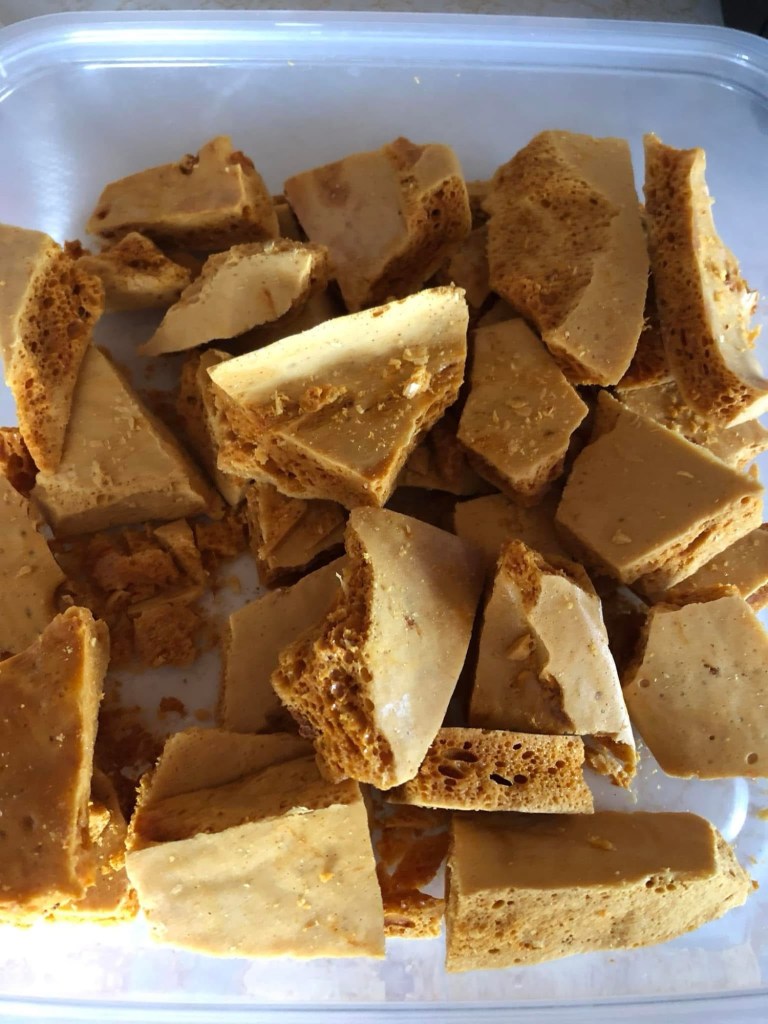
Here’s a fun and easy Honeycomb Candy recipe made with honey. This light, crunchy candy has a bubbly, toffee-like texture — perfect for snacking or dipping in chocolate.
Honeycomb Candy (with Honey)
Prep time: 5 minutes
Cook time: 10 minutes
Cool time: 30 minutes
Yield: About 20 pieces
Ingredients:
1 cup granulated sugar
1/4 cup honey
1/4 cup light corn syrup (or golden syrup)
2 tablespoons water
1 1/2 teaspoons baking soda (sifted)
Instructions:
1. Prepare your setup:
Line an 8×8-inch (or similar) baking pan with parchment paper. Measure out your baking soda and have it ready — once the sugar mixture reaches the right temperature, you’ll need to work quickly.
2. Cook the sugar mixture:
In a medium, heavy-bottomed saucepan, combine the sugar, honey, corn syrup, and water. Stir gently over medium heat until the sugar dissolves. Stop stirring and let the mixture boil undisturbed until it reaches 300°F (hard crack stage) on a candy thermometer — about 5–7 minutes. The color should be a deep golden amber.
3. Add baking soda:
Immediately remove the pot from heat. Quickly and carefully whisk in the baking soda — the mixture will foam up dramatically! Pour it immediately into the lined pan without spreading it (you don’t want to deflate the bubbles).
4. Cool:
Let the candy sit undisturbed at room temperature for about 30 minutes, or until fully set and hardened.
5. Break and store:
Once cooled, lift it out and break into pieces using your hands or a sharp knife. Store in an airtight container to keep it crisp (humidity will make it sticky).
Optional:
Dip in chocolate: Melt dark or milk chocolate and dip the honeycomb pieces halfway for a delicious twist. Sprinkle with sea salt right after pouring it into the pan for a sweet-salty combo.
 Not Your Grams Kitchen